A Life in Music

Timeline

This timeline documents Parissa's artistic career and activities across the decades — an ongoing effort. If you hold photographs, press clippings, programmes, or similar material, we would be grateful if you shared it with us.

Browse the performances index

Entry type

2026

Parissa Legacy, LLC — Avaz classes begin; residence in Irvine

Parissa Legacy, LLC is launched as the official entity preserving and promoting the artistic heritage of Parissa, under her supervision and the stewardship of her immediate family. Its public face is parissalegacy.org — the authoritative reference for her biography, timeline, discography, and video archive, and the home for programs offered in her name.

Through Parissa Legacy, Parissa begins ongoing Avaz classes: guided study of Persian classical vocal music and the vocal Radif, with attention to technique, poetry, and master–student transmission. Instruction is taught by Parissa herself and is structured for group and private study, in person and via Zoom. Placement and pace are guided by Parissa; an introductory conversation may precede access to study materials. In-person group classes in Irvine, California, open first for enrollment; private study and Zoom formats are part of the program catalog and open as schedules allow. Current offerings, session times, and registration are published on the Classes page of this site.

Parissa is residing in Irvine, California, until further notice. Parissa Legacy, LLC maintains its mailing address in Irvine (Orange County).

2026

Spectrum News 1 — Los Angeles

Human-interest report published March 9, 2026 on the Farhang Foundation's Nowruz concert at UCLA Royce Hall (March 8). As many in the Iranian diaspora prepared for Nowruz amid unrest in the Middle East, Spectrum News 1 Los Angeles frames Light Always Prevails as an evening uplifting Iranian women's voices — with concert footage of Parissa alongside Golda Zahra, Maestro Shahab Paranj, and the Iranshahr Orchestra. Report by Maryssa Rillo.

2024

Gathanik — From Silence to Mysticism

Literary-critical profile by Sama Babayi — «Az Sokut ta Erfan» («From Silence to Mysticism»), Gathanik, December 2024. A substantial biographical essay in the outlet's «Women of Music» series, placing Parissa in the canonical lineage of Iranian women's vocal art and reading her career through resilience, mysticism, and the Qamar al-Moluk Vaziri tradition.

Persian-language appraisal (English gloss): Babayi writes that she is "one of the most important women of Iranian āvāz, whose name will shine forever beside figures such as Qamar," and describes a "feminine mysticism" in her art — "among the few women to have reached the essence of a male mystical idiom… without clamorous gestures, she uses her own body to convey the feeling within her music." The essay recirculates Lloyd Miller's line that she "sang like an angel" in Mahmoud Karimi's class, and Parissa's own account of studying Qamar's tahrir: "I have always tried to use Qamar's kind of tahrir… their style is wholly different from today's singing." On the post-revolution years it quotes her on preserving tradition "with tooth and nail" and on the spiritual purpose of Iranian music: "What matters is the essence of this music… the message of Iranian art and music is the building of the human soul — especially Iranian music, which is fused with mysticism."

2019

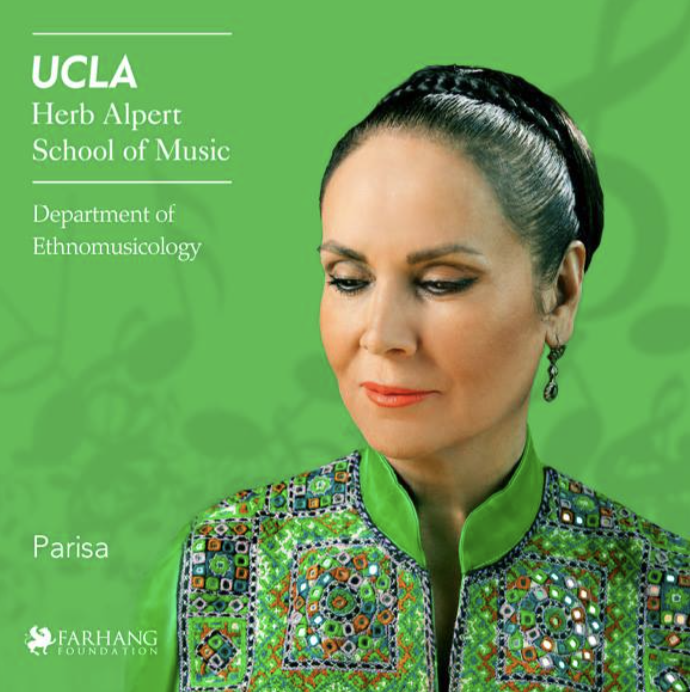
UCLA Herb Alpert School — Iranian Music Degree Program

UCLA Herb Alpert School of Music, Department of Ethnomusicology — instructor in the historic Iranian Music Degree Program. Winter and Spring quarters 2019: Persian Vocal Music (Ethnomusicology 91L and 161L), Wednesdays 12–3 p.m., Schoenberg 1659. Announced by Farhang Foundation as one of the foremost masters of Iranian classical music joining UCLA to teach her craft to students in the program. Parissa brings the vocal Radif — the classified repertoire of Persian traditional music, preserved through oral transmission and the basis of improvisation in this tradition — and the traditional vocal techniques through which it is learned. The Radif's ornamentation and nuance cannot be fully captured in notation; it is transmitted directly from master to student, a pedagogy Parissa has upheld since her training at the Center for Preservation and Propagation of Iranian Music under Dr. Dariush Safvat and through decades of international performance and teaching after the Revolution ended her public career in Iran. Opening ceremony on the UCLA campus (Schoenberg Music Building): Parissa with Amir Pourjavady (tar) and Pejman Hadadi (tombak).

Persian-language press — *Kayhan London* (فیروزه خطیبی / Firouzeh Khatibi, Sunday 5 Esfand 1397 / 24 February 2019): «گفتگو با پریسا بانوی آواز ایران؛ حافظ به ما گفت: یوسف گمگشته باز آید به کنعان غم مخور…» — full interview conducted minutes before a *radif* class at UCLA, while she was rehearsing for Farhang's eleventh Nowruz at Royce Hall (10 March 2019). Parissa deflected the title "ostad," insisting she remained a student and learner who loved to teach. She reflected on the long silence after the Revolution — nearly two decades without music while raising children — and how private teaching and inner study of the tradition's philosophical and mystical dimensions eventually renewed her voice; she traced her mystical outlook to Dariush Safvat at the Center from 1352. On art and the artist she insisted sincerity forbids separating the two; on gender she argued that what matters is the quality of the music, not sex — "کیفیت موسیقی مطرح است نه جنسیت." On teaching at UCLA she said opportunities abroad allowed work she could not pursue inside Iran and might help future audiences worldwide encounter this music. For the Royce program she chose poetry and old rhythmic pieces with deliberate message, including a *Bayāt-e Eṣfahān* setting drawn from a Hafez *fal*: "یوسف گمگشته باز آید به کنعان غم مخور." A same-day *Javanan Magazine* Facebook share («پریسا» گوهر یکتای موسیقی ایران…) previewed the Farhang Nowruz concert and quoted Farhang executive director Alireza Ardekani on welcoming her to Los Angeles while she taught in the Herb Alpert Iranian music program.

Radif class — UCLA (2019)

Social media coverage by Koronmusic (کُرُن موزیک) documenting a Persian Vocal Music session during Parissa's UCLA residency.

Courtesy Koronmusic (@koronmusic) — Saqi-nameh in class; UCLA Herb Alpert School of Music, winter/spring 2019. Video archived from instagram.com/reels/DOstyGoDJtF/

Opening ceremony — Schoenberg Music Building

Courtesy @rang.a.rang7 — opening ceremony performance; Parissa with Amir Pourjavady (tar) and Pejman Hadadi (tombak); Schoenberg Music Building, UCLA Herb Alpert School of Music, 2019
2019

Farhang Foundation — 11th Annual Nowruz

Sunday, March 10, 2019 — UCLA Royce Hall and Dickson Court. Farhang Foundation presented the largest Nowruz celebration in the United States: a free, daylong public festival on Dickson Court (noon–5 p.m.) with the annual Spring Walk parade, a grand Haft-Sîn display, Iranian Tea House, children's programming, dance and folk performances, and street banners by competition winner Sharareh Khosravani announcing the arrival of spring.

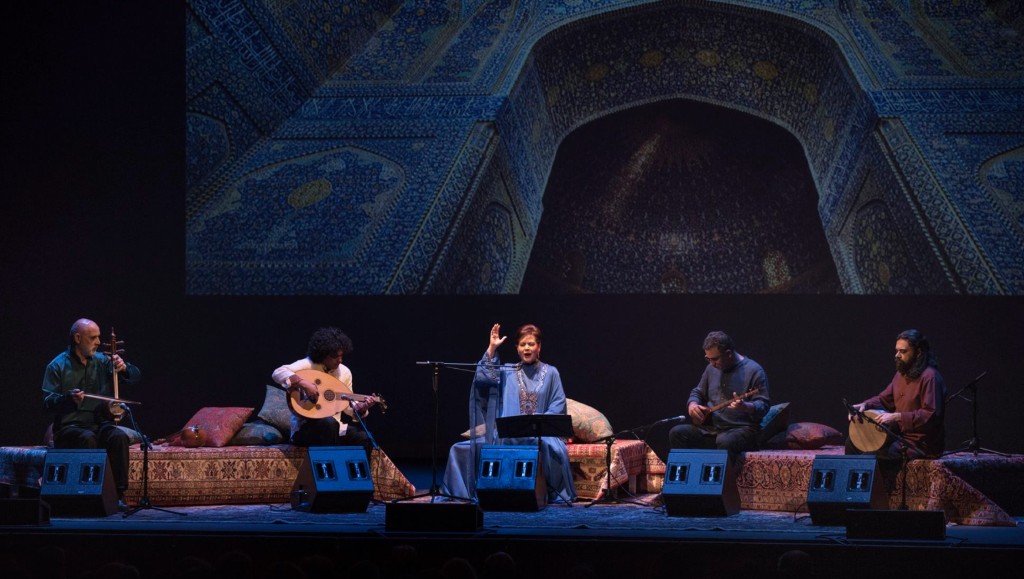
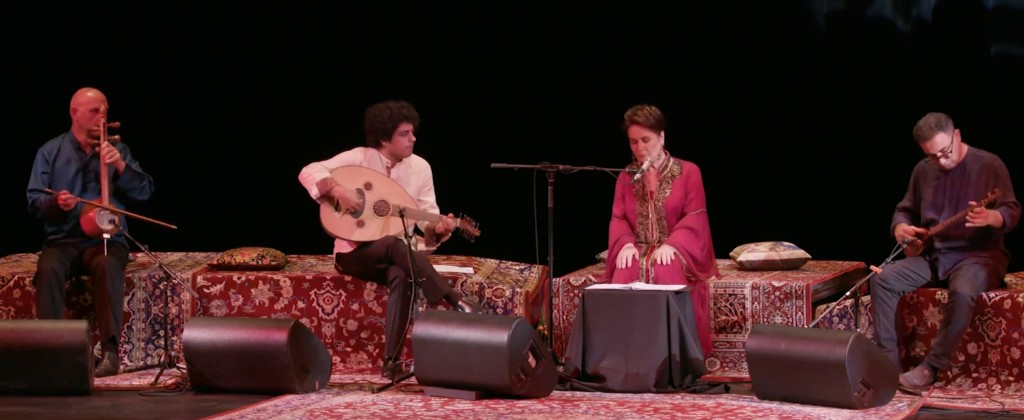
Headlining concert — 6 p.m., Royce Hall (ticketed). Farhang billed Parissa as "the grande dame of Iranian classical music." She performed with Hamnavazan: Amir Hossein Pourjavady (setar), Pejman Hadadi (tombak), Saeed Kamjoo (kamancheh), and Ali Pajooheshgar (oud) — on Persian rugs with monumental architectural projections behind the ensemble. Executive director Alireza Ardekani noted that Farhang had admired Parissa for decades and was delighted to welcome her to the Royce Hall stage. In conjunction with the concert, Parissa was invited to teach at the UCLA Herb Alpert School of Music through the Iranian music initiative supported by Farhang Foundation during her Los Angeles residency that winter and spring — the same week she also gave her Stanford Festival of Iranian Arts talk and concert (April 25–26) and performed for the Persian Cultural Center in San Diego (April 27).

2019

Breakfast With Homa Sarshar — radio interview

Farhang Foundation — video of Parissa in conversation with journalist Homa Sarshar on Breakfast With Homa Sarshar, ahead of the foundation's eleventh annual Nowruz celebration at UCLA (February 2019; the published clip is dated 23 February 2019). Farhang's caption read: "Parisa, the grande dame of Iranian music discusses her career and upcoming March 10th Nowruz Concert with legendary journalist Homa Sarshar on Breakfast With Homa Sarshar." Parissa reflects on her path in Persian classical music and the Royce Hall concert.

(Third-party publicity spells her name Parisa.)

Courtesy Farhang Foundation — Breakfast With Homa Sarshar interview (February 2019). Source: facebook.com/FarhangFoundation/videos/2239815526262087/
2019

Stanford — lecture & workshop

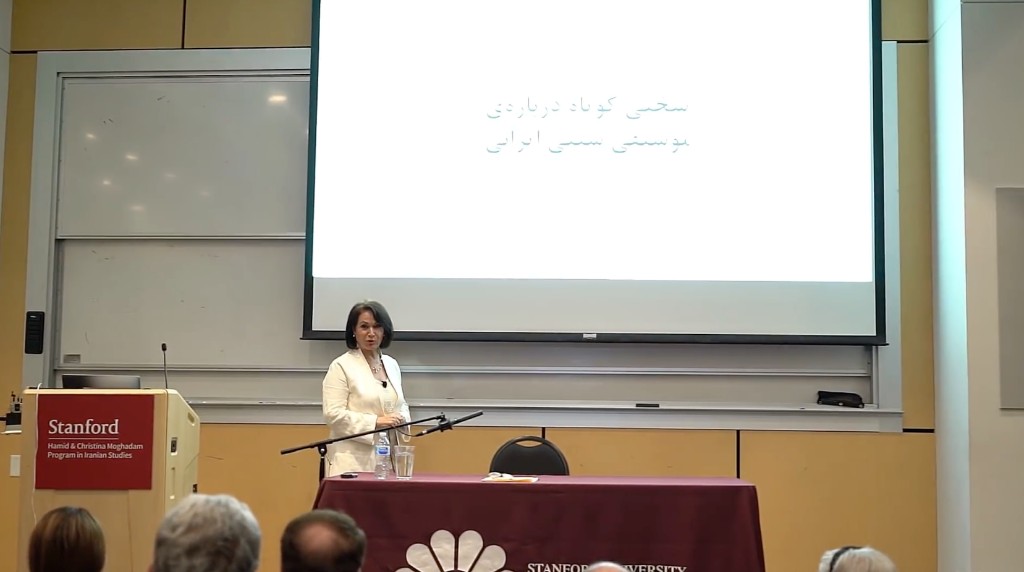
Hamid and Christina Moghadam Program in Iranian Studies — talk and workshop "The Art of Iranian Classical Music: History, Context, and Purpose," delivered in Persian as part of the Stanford Festival of Iranian Arts. Thursday, April 25, 2019, 6:30–8:00 p.m., Bishop Auditorium, Lathrop Library. Parissa traced the lineage of the vocal Radif from Mirza Abdollah through oral transmission, the path from radif performance to improvisation (badiheh-pardazi), and the four qualities she argued distinguish Iranian music — traditional, national, original (asil), and classical. Illustrated slides addressed the nomenclature of the tradition, gnosticism (erfan) as articulated by Ostad Elahi, and musical examples such as "Jameh-Daran."

Lecture — Bishop Auditorium, April 25, 2019

Presentation slides (delivered in Persian)

2019

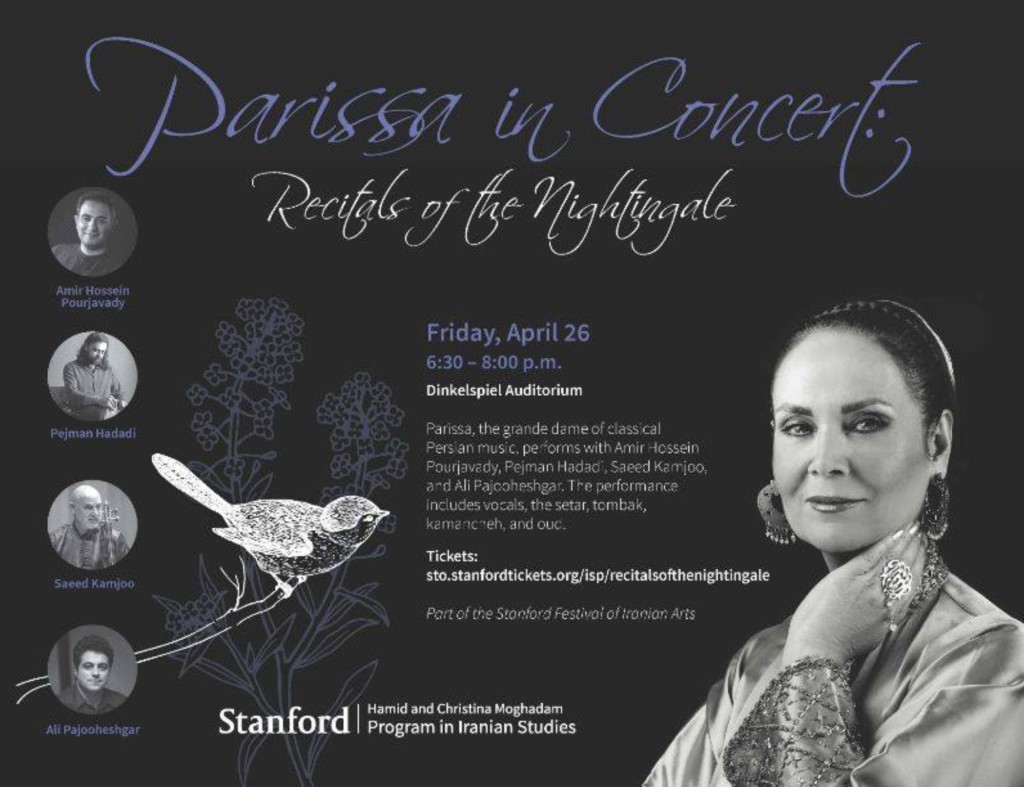
Parissa in Concert: Recitals of the Nightingale

Hamid and Christina Moghadam Program in Iranian Studies — Stanford Festival of Iranian Arts. Parissa in Concert: Recitals of the Nightingale. Friday, April 26, 2019, 6:30–8:00 p.m., Dinkelspiel Auditorium. Presented the evening after her Persian-language workshop on the history, context, and purpose of Iranian classical music at Bishop Auditorium, Lathrop Library (April 25). Hamnavazan: Amir Hossein Pourjavady (setar), Pejman Hadadi (tombak), Saeed Kamjoo (kamancheh), and Ali Pajooheshgar (oud). Stanford billed the concert as a recital by "the grande dame of classical Persian music"; promotional imagery was supplied courtesy of the Farhang Foundation. The same quartet accompanied Parissa in San Diego the following night (April 27). Concert photographs: Vahid Zamani (Stanford Iranian Studies).

2019

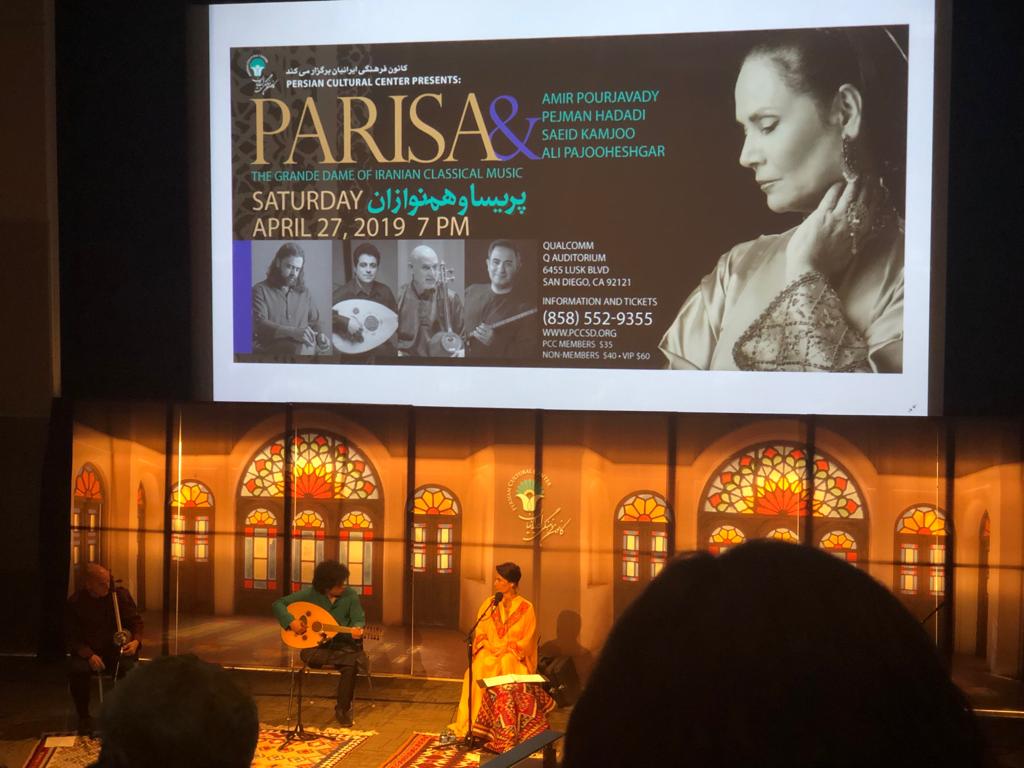
Persian Cultural Center — San Diego

Persian Cultural Center of San Diego presents Parissa — "The Grande Dame of Iranian Classical Music." Qualcomm Q Auditorium, 6455 Lusk Blvd, San Diego; Saturday, April 27, 2019, 7 p.m. Ensemble (Hamnavazan): Amir Pourjavady, Pejman Hadadi, Saeid Kamjoo, Ali Pajooheshgar. Among the center's major 2018–2019 cultural programs, documented in the PCC annual report as the Parissa & Hamnavazan concert at the Q hall.

2019

Tirgan Festival, Toronto

Headline concert — Tirgan Festival, the world's largest celebration of Iranian arts and culture (Toronto, July 25–28, 2019; theme: Unity). Friday, July 26, 2019, 7 p.m., Bluma Appel Theatre, St. Lawrence Centre for the Arts.

Tirgan billed Parissa as "the Grande Dame of Iranian classical music" and promoted the evening as "a concert full of memory and mysticism" — one of the festival's centerpiece performances, in an edition featuring more than 230 artists across Harbourfront Centre, the Distillery Historic District, and St. Lawrence Centre.

Program: a journey through the dastgāh of *Māhur* and *Āvāz-e Esfahān*, with poetry of Hafiz, Sa'di, and Mowlana (Rumi) — themes of separation from the Source and the longing to return that define Persian classical song and Parissa's repertoire. Hamnavazan: Pejman Hadadi (tombak), Ali Pajooheshgar (oud), Amir Hossein Pourjavady (setar), and Saeed Kamjoo (kamancheh), seated on Persian rugs under warm stage lighting.

Honors: At the festival, Tirgan presented Parissa with its Arash statuette — the festival's signature tribute, named for the archer of Persian legend — in recognition of her lifetime contribution to the vocal *Radif*. Tirgan documented the presentation on its official Instagram account; Parissa received the award on stage in her embroidered magenta robe, with festival leadership and guests applauding from the wings. Local audience footage captures the on-stage presentation moment (see gallery below).

Press: Toronto.com (Alidad Mafinezam, July 2019) wrote that Parissa "continues to play a key role in the preservation and promotion" of classical Persian music, and that to hear authentic Iranian art "one has to come to Toronto." Ātash (July 2019) singled out the concert among the festival's must-see programs.

Concert — Bluma Appel Theatre

Arash statuette — festival tribute (July 2019)

Tirgan's signature award, presented on stage at the Bluma Appel Theatre.

Local audience footage — Arash statuette presentation on stage, Tirgan Festival, Toronto, July 2019
2018

Bita Prize for Persian Arts

11th Bita Prize for Persian Arts — Stanford University, Friday November 9, 2018, Cemex Auditorium. The Hamid and Christina Moghadam Program in Iranian Studies honored Parissa for a life dedicated to preserving the best of Iranian classical music and elevating the role of women in this tradition. Stanford's citation reads: "Her exemplary role as the embodiment of the dignity of an artist, undaunted by the commercial market or power, makes her yet another impressive and indispensable addition to the list of Bita Prize recipients." The ceremony drew more than 450 guests; Abbas Milani and Bita Daryabari spoke, and Parissa performed with Dara Afraz and Emile Richard. Signed copies of Ahvale Del (album released 2013; see discography) were distributed at the ceremony.

Persian-language reception: BBC News Persian (Amir Rostaq, «Parissa, a singer for all seasons,» November 11, 2018) framed her career in three periods — pre-revolution ministry and Center years, post-revolution "years of silence," and international concert life from the mid-1990s — and tied the Bita award to her teaching of women the vocal Radif at home when public performance was barred. Iran International (Mehrdad Rahsepar, «پریسا؛ از تدریس در ایران تا ۲۲ سال کنسرت در اروپا و آمریکا,» 18 Aban 1397 / 9 November 2018) published a same-day career profile for the award: Karimi and Safvat as formative teachers; ministry years and early France tours; Center training with Davami; the post-revolution turn to teaching women; her refusal of women-only concerts in Iran; and more than two decades of international performance from 1995 with Dastan and others, including a 2017 UC San Diego *radif* teaching residency. A separate Iran International ceremony report (November 10, 2018) titled her «banu-ye āvāz-e Irān» (the lady of Iranian āvāz) and reported that Abbas Milani opened the ceremony as the first speaker on her place in Iranian music and culture, referencing Qamar al-Moluk Vaziri's pre-revolution concert and the prohibition on solo performance by women in Iran today. That report also quoted her on Dariush Safvat: «استاد صفوت مرا از جسم موسیقی گذر داد و با روح موسیقی آشنا ساخت» (“Ostad Safvat carried me past the body of music and acquainted me with the soul of music”).

IranWire ceremony report (ماهرخ غلامحسین‌پور / Mahrokh Gholamhosseinpour), republished on Milliun Iran as «بیتا دریاباری: فرهنگ تجلیل از یک هنرمند مرده را باور ندارم»: Bita Daryabari, presenting the award, said Parissa never abandoned the standards and dignity of an artist — choosing house-bound integrity over cheap presence — and told IranWire she does not believe in the culture of honoring a dead artist: if one can act, one must honor an artist's work while she is still alive, and she wanted one of the world's most respected universities to remind Parissa that Iranian society still values her art. On stage Parissa spoke of Karimi, Safvat, Davami, and Nur Ali Elahi; described authentic Iranian music as meaning-bearing (*maʿnāgar*), not a vehicle for fame, wealth, or entertainment; and dedicated the Bita trophy to her students and to women artists of Iran who continue to preserve and propagate the tradition under pressure.

2017

Visiting Professor, UC San Diego

Inaugural holder of the Roghieh Chehre-Azad Distinguished Professorship in the Division of Arts and Humanities — established by Distinguished Professor Siavouche (Sia) Nemat-Nasser and Éva Nemat-Nasser in honor of his mother. Spring quarter 2017: Parissa taught introductory and advanced courses in the vocal Radif and Persian traditional vocal technique.

Roghieh Chehre-Azad Distinguished Professorship Talk — Conversations with Master Parissa. Tuesday, April 4, 2017, 5 p.m., Conrad Prebys Music Center Recital Hall. Presented by the Division of Arts and Humanities; introduction by Dean Cristina Della Coletta. Campus publicity invited the community to RSVP through the Iranian Student Association at UC San Diego (ISTAUCSD.org).

During the residency, Parissa also offered master classes for the Persian community in Los Angeles and San Diego, arranged by Professor Shahrokh Yadegari in partnership with the Persian Cultural Center of San Diego and the Persian Arts Society of Los Angeles.

2016

Barbican Centre, London — Rumi anniversary

Rumi anniversary celebration with Meshk Ensemble — Saturday, 1 October 2016, as part of Transcender, the Barbican's festival of ecstatic, devotional, and psychedelic music from across the globe. A concert of interpretations of Rumi's poetry on raised platforms draped in Persian rugs, with kamancheh, tar, and tombak, under the Barbican's characteristic stage lighting.

Venue promotional copy: Barbican posters and brochures billed Parissa + Meshk Ensemble with the line "A voice crystal clear… refined and deeply emotional," attributed to the Asia Society, New York — venue marketing that reused shortened festival-program praise; the original critical line is from a 2003 Australian review of Shoorideh (The Planet, ABC Radio National), not an Asia Society concert review (see those timeline entries).

Western press: T-VINE Magazine (UK, 2016) wrote that "few artists bring life to Rumi's poetry quite like Parissa" and that her "striking vocals portray the full range of emotions in Rumi's words, tapping into the spiritual qualities of his work." Iranian writer Masoud Behnoud, quoted in Euronews coverage of the event, observed that "although Parissa has not been performing on stage, we have been living with her voice for forty years" — and that she remains "the heavenly angel of Iranian music."

Persian-language reception: Euronews Persian («Parissa on Iranian music and mysticism,» October 2016) presented her as a enduring star of Iranian music and quoted her artistic credo: "The message of Iranian art and music is the building of the human soul — especially Iranian music, which is fused with mysticism… what matters is the essence of this music." On women-only concerts in Iran she told Euronews: "This music has nothing to do with whether the listener is a man or a woman… it speaks of the soul, which is shared among all human beings" — a stance she has repeated across Persian interviews since the 2006 BBC Persian report on her Paris concert.

2014

Festival d'Île de France — Tabous, musiques et interdits

Sunday, October 5, 2014, 5 p.m. — Théâtre Municipal de Fontainebleau (77), as part of the festival season Tabous, musiques et interdits (September 6–October 12). Parissa performed Persian classical music with Madjid Khaladj and Iman Vaziri.

2014

Persian Arts Society — Avaz lessons

Individual and group Avaz lessons with Parissa — March 24 through April 30, 2014, at the Persian Arts Society of Los Angeles (11312 Santa Monica Blvd., West Los Angeles). The society's flyer announced instruction with "The Legendary Master of Iranian Avaz" through its School of Music program; Parissa's official Facebook page shared the poster on March 16.

2013

United States tour — November 2013 (Live in Concert)

Parissa returned to the United States in November 2013 under the shared Live in Concert promotion — a Dastan Ensemble tour across the Midwest and East Coast, a Carnegie Hall recital at its center, and a Southern California leg with Hamnavazan following the main dates.

Dastan Ensemble (November 1–10). Parissa & Ensemble Dastan: Chicago (Friday, November 1, 8:30 p.m., Donald E. Stephen Convention Center); Durham, North Carolina (Saturday, November 2, 7:00 p.m., Duke University, Reynolds Theater, Bryan Center); Atlanta (Sunday, November 3, 7:30 p.m., Unity North Atlanta, Marietta); New York (Friday, November 8, 8:30 p.m., Carnegie Hall, Zankel Hall); Philadelphia (Saturday, November 9, 7:30 p.m., McShain Auditorium, Bryn Mawr); Houston (Sunday, November 10, 8:00 p.m., Westchase Academy).

Carnegie Hall — Zankel Hall (November 8). Carnegie Hall Presents — Parissa & Dastan Ensemble, 8:30 p.m. The Carnegie Hall 2013–14 subscription brochure announced the concert as one of the foremost female vocalists from Iran, acknowledged for her command of the classical and Sufi genres of Persian music, performing centuries-old repertoire and fresh approaches to rarely heard songs of the past century. Presented in association with Robert Browning Associates, whose 2013–14 season in review recalls Parissa as Iran's foremost female vocalist and Dastan Ensemble among Iran's most important traditional groups, with Hamid Motebassem (tar), Hossein Behroozinia (barbat), Saeed Farajpoori (kamancheh), Hamin Honari (tombak), and Arjang Ataollahi (daf). The New York concert was the centerpiece of the Dastan tour leg. Ahvale Del, featuring Parissa with Saeed Farajpoori (kamancheh), was released the same year.

Time Out New York's listing for the concert (venue promotional copy, not an independent review) echoed Carnegie Hall program language: "Parissa is one of the foremost interpreters of Iranian classical music in the world… Here, she raises her sumptuous voice in eloquent songs of love and devotion, accompanied by her renowned countrymen of the Dastan Ensemble."

Hamnavazan Ensemble — Southern California (November 16–17). Following the Dastan dates, Parissa & Hamnavazan Ensemble continued under the same Live in Concert branding. San Diego: Saturday, November 16, 7:00 p.m., presented by the Persian Cultural Center (PCC) at the Neurosciences Institute, 10640 John Jay Hopkins Dr., San Diego. Orange County: Sunday, November 17, 6:30 p.m., presented by Nava Entertainment & SIGS at Social Science Lecture Hall, UCI (Stanford & Campus Drive, Irvine).

2013

Sarv Music Academy, Toronto — master class

Sarv Music Academy, Toronto — master class in singing and Iranian Dastgah music with Parissa. Thursday, August 29 and Friday, August 30, 2013, 7:00–9:00 p.m. each evening (limited capacity). Sarv Music Academy, 2 Greenview Avenue, Toronto, Ontario.

2012

West USA and Canada tour — Hamnavazan Ensemble

Parissa & Hamnavazan Ensemble — West USA and Canada tour (May–June 2012). Vancouver: Sunday, June 10, 2012 — first half, Saeed Farajpoori compositions in Avaz-e Bayat-e Esfahan with Rumi poetry; second half, earlier repertoire in Avaz-e Bayat-e Tork. The tour concluded in Sacramento, California (see following entry). Ensemble: Saeed Farajpoori (kamancheh), Hamid Henri (tombak), Hossein Behroozinia (barbat), Saina Khalili (santur).

2012

Sacramento — tour finale

Sacramento, California — the closing concert of the May–June 2012 Hamnavazan tour. After Parissa and the ensemble performed, Mohammad Reza Shajarian came forward from the audience to greet her on stage — widely reported as their first close encounter in person. The evening became an exceptionally rare public meeting of two masters of Persian classical vocal music: handshakes, flowers, and shared joy among the musicians and the audience. Contemporary accounts described a moment of unity, friendship, and warmth that transcended the usual distance between their careers.

After the concert — Parissa & Mohammad Reza Shajarian

2012

Resistance in Contemporary Middle Eastern Cultures

Central case study in Parmis Mozafari's chapter "Carving a Space for Female Solo Singing in Post-revolution Iran" (pp. 262–278) in Resistance in Contemporary Middle Eastern Cultures: Literature, Cinema and Music, edited by Karima Laachir and Saeed Talajooy (Routledge, 2012). Drawing on doctoral research at the University of Leeds and extensive interviews with Parissa in Tehran (August 2008), Mozafari examines how Iranian women singers have navigated the post-1979 prohibition on solo performance — and presents Parissa as the foremost example: trained under Mahmoud Karimi, shaped at CPPTMI under Dariush Safvat alongside Shajarian, she refused female-only concerts and co-singing as substitutes for avaz, performed abroad rather than compromise the tradition, and continued teaching women vocalists inside Iran through decades of silence.

2011

Musée Guimet, Paris

Musée Guimet, Paris — concert (April 2011). At the National Museum of Asian Arts, Parissa gave an evening of Persian classical vocal music with Bahman Panahi and Pedram Khavarzamini.

2011

Konya International Mystic Music Festival

8th Konya International Mystic Music Festival, Turkey — Thursday, September 29, 2011, 9 p.m., Mevlana Culture Center (Sultan Veled Hall), Konya. The festival runs September 22–30 each year in the city of Rumi, culminating on his birthday; concerts are free and open to the public. Parissa performed Persian classical music from the vocal Radif and Dastgah tradition on tiered platforms draped in Persian rugs, with Iman Vaziri (tar) and Madjid Khaladj (tombak and daf). While in Konya she also gave an interview to Radio Zamaneh (see following entry). A Persian-language news report on the concert — سالگرد تولد مولانا با آواز پریسا در قونیه — circulated widely after the festival (2013). The festival’s professional audio-visual team also records each concert for its archive; the full performance was released on the official Mystic Music Festival YouTube channel.

Persian festival interviews (2011): Mardomak (September 2011) recorded her artistic credo at the festival: «جوهر موسیقی مهم است. به‌هیچ‌وجه کار نمایشی مطرح نیست. کیفیت مطرح است. ظاهر و زرق و برق موسیقی موضوعیت ندارد» (“The essence of the music is what matters. Spectacle is not the point at all. Quality is the point. The glitter and surface of music are irrelevant.”) In other coverage she reiterated that gender is irrelevant to this art because “it speaks of the soul, which is shared among all human beings” (see also Euronews, 2016, and Gathanik, 2024). Radio Zamaneh recorded an extended interview on site (following entry).

2011

Radio Zamaneh — interview at Konya

Interview with Parissa, celebrated singer of Persian classical music — Shahzadeh Samarqandi (Radio Zamaneh), recorded at the 8th Konya International Mystic Music Festival, September 2011. Parissa speaks about her life and work in the days surrounding her festival concert in the city of Rumi.

2010

«Retirement at Age 26» — Deutsche Welle

Deutsche Welle Persian — «بازنشستگی در سن ۲۶ سالگی» («Retirement at Age 26»): a conversation with Parissa about her past and present. Published Tuesday, 14 September 2010 (23 Shahrivar 1389); interview by Bamdad Esmaeili. Parissa speaks about her artistic journey in Iran, the challenges facing women singers after the Revolution, and her enduring commitment to Persian classical music.

Key themes from the interview: she began singing in childhood and met Mahmoud Karimi at sixteen after winning national school arts competitions; at nineteen she began her professional career with the Ministry of Culture and Arts, and joining the Center for Preservation and Propagation of Iranian Music transformed her path. Her public performing career lasted less than nine years — in 1979, at twenty-six, she felt she had barely begun. After solo performance by women was banned, she remained in Iran rather than emigrate, devoted herself to family life, and studied Persian poetry, mysticism, and the philosophy behind the music; for sixteen or seventeen years she hardly sang at all. Teaching women the vocal Radif at home has since become her principal work. She has always declined invitations to perform exclusively for women in Iran, believing that to accept such conditions would contradict everything she stood for before the Revolution. On artistic integrity: "Artists who remain true to their principles, regardless of circumstances, are the ones whose work endures." On why her style has remained unchanged: "When you truly believe in certain artistic, ethical, and spiritual principles, you do not abandon them simply because circumstances change." On aging: "I am a realist. I never run away from reality."

2010

Festival of Sacred Sounds — Santiago de Compostela, Spain

Festival of Sacred Sounds (صداهای مقدس), Santiago de Compostela, Spain — with Iman Vaziri (tar) and Dara Afraz (tombak), continuing the Simplicity program from the 2008–09 European touring cluster (Voix de Femmes, Brussels; Musica dei Popoli, Florence; Santander, 2009; Uppsala Sacred Music Festival, 2009). Persian Wikipedia concert chronology places this among her Spanish festival appearances alongside Barcelona (QADAR Festival) and Santander (2009).

2009

Uppsala International Sacred Music Festival

Uppsala International Sacred Music Festival, Sweden — Friday, October 30, 2009, Stora salen, Uppsala Konsert & Kongress. Parissa presented the Simplicity program in two sections (Abuata and Mahur) for Iranian and Swedish audiences, organized with the Pouyeh Cultural Center, Paris (Abbas Bakhtiari). The concert opened with a prelude in Dastgah-e Shur; ensemble: Iman Vaziri (tar), Ehsan Zabihifar (kamancheh), and Dara Afraz (tombak). Repertoire drew on the Simplicity album and Rumi’s poetry throughout. BBC News Persian published a full concert report on 1 November 2009 (گزارشی از کنسرت پریسا در سوئد), surveying her career from the Center for Preservation and Propagation of Iranian Music through her return to international performance. Also reviewed in Uppsala Nya Tidning as part of the festival’s closing weekend.

Swedish festival program notes quoted international press: "Unique in every way" (Le Monde), "The crystal clarity of her songs" (Libération), "A vocal miracle" (Jazzethik). The program described her as "one of the foremost singers of classical Persian music" whose "emotional intensity, coupled with the crystal clarity and always warmth of her voice, have attracted a large and devoted following the world over."

2009

Festival Internacional de Santander

Festival Internacional de Santander (FIS), Cantabria, Spain — Saturday, August 8, 2009, Lombraña (Polaciones). Parissa performed Persian classical vocal music from the Simplicity repertoire in the Marcos Históricos cycle — concerts held in historic churches and villages across the region, distinct from the main Palacio de Festivales in Santander. Trio: Iman Vaziri (tar) and Dara Afraz (tombak); no kamancheh on this program.

2009

Muslim Voices Festival — Asia Society

Muslim Voices: Arts & Ideas — Asia Society, New York — Parissa: An Evening of Persian Classical Music. Thursday, June 11 and Friday, June 12, 2009, 7:30 p.m., Lila Acheson Wallace Auditorium. Parissa sang the poetry of Rumi with Iman Vaziri (tar) and Dara Afraz (tombak); pre-concert lectures on Persian music by Stephen Blum and Ameneh Youssefzadeh on both evenings.

Western critical reception: Alex Ross (The New Yorker, blog "The Rest Is Noise," June 15, 2009) wrote that "the Persian classical singer Parissa gave ethereally powerful performances of mystical poems of Rumi" and that "the somber major-key melody with which she closed, a majestic slow march, rang in my ears all weekend." Lucid Culture (June 12, 2009), in an independent concert review, called the evening "arguably the highlight of this year's Muslim Voices festival" and described her as singing "in a vibratoless alto more bronze than brassy" with "melismas and ululations which she delivered with considerable passion yet restraint." Stephen Blum (CUNY), in the Asia Society festival program essay "The World of Persian Music and Poetry" (2009), analyzed the architecture of her performance — a rare Western source on dastgāh structure rather than impression alone: "Parissa designed a plan that began in the dastgāh of Māhur, modulates to Afshāri and then to Segāh, before returning to Māhur… six rounds of sāz and āvāz followed each time by a tasnif or zarbi."

Festival program copy quoted her voice as "at once refined and deeply emotional" with attribution to The Planet, Australia — a shortened reuse of a 2003 ABC Radio National review of Shoorideh (see that timeline entry), not an Asia Society critical review. The festival's own prose on "perfection" and "simplicity" in interpreting Rumi is separate venue copy.

2008

European tour — Simplicity

Expanded Simplicity program with kamancheh — Iman Vaziri (tar), Ali Rahimi (tombak), Ehsan Zabihifar (kamancheh). Düsseldorf (14 November, Palais Wittgenstein), Paris (see following entry), Rennes (22 November, MJC Bréquigny). Florence — Musica dei Popoli, Auditorium FLOG (Saturday, October 4); Barcelona — L'Auditori, 13è Festival de Músiques del Món (Sunday, October 5, Simplicity program).

Musica dei Popoli — Florence, October 4, 2008

Festival de Músiques del Món — Barcelona, October 5, 2008

2008

Paris — Simplicity concert (2008)

Paris — Simplicity with Iman Vaziri (tar), Ali Rahimi (tombak), and Ehsan Zabihifar (kamancheh). Concert footage is titled Concert de Parissa à Paris (November 17, 2008). Tour publicity also listed a performance at Salle Adyar (November 16) on the same Paris visit. For Parissa at the National Museum of Asian Arts, see Musée Guimet (2011).

Paris — November 2008

Concert de Parissa à Paris — November 2008
2007

Simplicity — album release

Simplicity — Parissa (vocals), Iman Vaziri (tar, composition), Ali Rahimi (tombak). Cologne Music, 2007. Persian classical improvisation in Dastgah-e Mahur, with poetry by Rumi.

In her liner essay «Perfection Is in Simplicity» (کمال در سادگی است), Parissa writes that true art and spirituality aim to shed ego, desire, and excess until only essence remains — like electricity needing two poles, yet returning toward simplicity. A musician's impact, she argues, depends less on technique than on whether the higher soul masters instinct; she praises Iman Vaziri for approaching Rumi without display or artifice. The recording opens with improvisation, Daramad and Goushe-ye Khosravani in Mahur, on a ghazal from Rumi's Divan-e Shams — verses on shedding the "human garment," the musician of Love, dancing in the circle of unity, and the Saqi who brings light through self-effacement.

8th Festival Voix de Femmes (Brussels, Liège, Antwerp) — Saturday, December 8, 2007, 22:00, Flagey studio 4, Brussels. Same Simplicity program with Iman Vaziri (tar) and Ali Rahimi (tombak); master classes and workshops across the festival.

Liner notes — «Perfection Is in Simplicity»

Festival Voix de Femmes — Brussels, December 8, 2007

2007

Fes Festival of World Sacred Music

Dar Batha (Musée Batha), Fes — Gol-e Behesht with Dastan Ensemble, Saturday 2 June 2007, 4:30 p.m., as part of the festival's intimate afternoon series. The Batha Museum is a former royal palace at the edge of the Fes el-Bali medina; its Andalusian garden courtyard, with white horseshoe arches and zellij fountains, is one of the festival's most beloved venues. Afternoon concerts here are staged in the shade of a massive Barbary oak — the festival's own publicity described it as a century-old tree, while later accounts speak of a venerable oak whose canopy has sheltered generations of performances, with birds from the surrounding gardens often audible above the music. Parissa and Dastan presented settings of Sufi poetry by Rumi from Gol-e Behesht (Les Roses du Paradis). A concert excerpt is embedded below (1:40–3:23). Among those in Fes that week were U2 and Brian Eno; contemporary accounts report that the band attended this concert and were struck by the scale and form of the music — the first piece lasting some forty-five minutes, the second thirty — far from conventional pop song structure.

2006

Théâtre de la Ville, Paris

Gol-e Behesht ("La fée Parissa" / The Fairy Parissa) with Dastan Ensemble — Saturday, December 2, 2006, at the Théâtre de la Ville (grande salle), before a capacity audience of more than a thousand, largely non-Iranian listeners. Ensemble: Hamid Motebassem (tar), Hossein Behroozinia (barbat), Saeed Farajpoori (kamancheh), Pejman Hadadi (tombak), and Behnam Samani (daf). Shahrokh Golestan's report for BBC Persian includes an interview on the spiritual dimension of Persian classical music, her refusal of women-only concerts, and her preference for setting eternal poetry by Hafez, Rumi, Sa'di, and Attar.

Persian-language reception: Golestan quotes her on the depth of the music: "What we do at this level is about its spiritual aspect… it has nothing to do with whether the listener is a man or a woman." On performing for non-Persian audiences she said the music's philosophy and spirituality are "so great that they can be offered to all the peoples of the world," and that many non-Iranian listeners connect to its inner dimension even without understanding the poetry. G. Keshani («Adam-e Khoshunat,» 2022) on this Paris period: «خانم پریساکه صدای مخملین و تحریرهای شگفت‌انگیزش را در هیچ صدای دیگری ندیده‌امبا گروه دستان در پاریس به اجرایی می‌پردازد که هوش از سر می‌رباید» (“Madam Parissa — whose velvet voice and astonishing tahrir I have found in no other voice — gives, with the Dastan Ensemble in Paris, a performance that carries the mind away”).

French program notes (article: "L'art du radif") described her as having a "voice of velvet, voice of loving sharing with her audience and with the musicians on stage" and noted her name Parissa means "fairy" in Persian.

2006

North American Gol-e Behesht tour

North American Gol-e Behesht tour with Dastan Ensemble — Montreal, Ottawa, Toronto, Vancouver, New York (World Music Institute, Peter Norton Symphony Space, Saturday, September 16, 8:00 p.m.), Atlanta, Dallas, Chicago, Ann Arbor, Orange County, Los Angeles (September 30), San Francisco, and San Diego. Madrid (Veranos de la Villa festival, Jardines de Sabatini, July 1, 22:00) presented the Shoorideh program earlier that summer.

Los Angeles — September 30, 2006

Gol-e Behesht with Dastan Ensemble. Selection below; Pars Times hosts the full concert gallery (© parstimes.com).

World Music Institute — September 16, 2006

Veranos de la Villa, Madrid — July 1, 2006

2006

Nansa Intercultural Festival — Cantabria

Nansa Intercultural Festival, Cantabria, Spain — Saturday, July 8, 2006, Jardines de la Casona de Tudanca, 20:30 (free admission). Program series *El cantar de las culturas*; concert titled "Del mar Mediterráneo al mar Caspio" (From the Mediterranean to the Caspian Sea), presenting Parissa with Dastan Ensemble in the Saja-Nansa valley — distinct from the Festival Internacional de Santander (FIS) Simplicity concert in Lombraña, August 8, 2009 (see that entry).

Nansa Intercultural program — July 2006

2005

Gol-e Behesht — album release

Gol-e Behesht released with Dastan Ensemble (Network Medien cat. 29.204, 2-CD set; recorded February 2005, Rundfunk Berlin-Brandenburg). CD1 — Dastgah-e Isfahan, compositions by Hamid Motebassem; CD2 — Dastgah-e Abu-Ata, compositions by Hossein Behroozinia; lyrics from Sa'di, Rumi, Nizami, Araghi, and Niaz-e Joshaghan. Ensemble: Motebassem (tar/setar), Saeed Farajpoori (kamancheh), Behroozinia (barbat), Pejman Hadadi and Behnam Samani (percussion); trilingual liner notes; distributed by Harmonia Mundi France.

Press (French): Sylvie Hamon in Rythmes Croisés calls her "one of the great female voices of Iran's classical singing" and finds "virtuosity and sensitivity… in every phrase and every note." Europe tour with Dastan Ensemble (Venice, Rome, Freiberg, Köln, Oslo (Oslo World Music Festival, November 6 — Kulturkirken Jakob, 19:00)); Tar & Setar seminar, Netherlands.

2005

Beauty and Perfection in Music — essay

Essay signed Parissa, Autumn 1384 (پاییز ۱۳۸۴ / 2005): «زیبایی و کمال در موسیقی» (Beauty and Perfection in Music). Written in her own voice as an eager student of music rather than as scholar or orator, the piece treats beauty (jamāl) and perfection (kamāl) as the foundation of effective art, drawing on Hafez, Rumi, and Suhrawardi's Ḥaqīqat al-ʿIshq (The Reality of Love), then reading criteria of beauty in nature — symmetry, harmony, intimacy, subtlety, purity, repetition, and ḥāl — and in Hafez's Saqi-nameh and Moghanni-nameh. It closes by distinguishing spiritual from sensual music and arguing that the musician herself must become beautiful for the music to raise the soul toward the Origin.

Presented on the timeline with an English overview for orientation and the essay body in the original Persian. Source status: preserved in a family press compilation; no independent print or online publication of this title under her name has been verified. A dossier footnote attributing it to Honar-e Mousighi no. 35 is a misattribution (that issue is Ordibehesht 1381 / 2002 and catalogs no Parissa essay).

Companion visual: "Dancing Dervishes," folio from a Divan of Hafez, painting attributed to Kamāl ud-Dīn Behzād (Bihzad), Herat, ca. 1480 — The Metropolitan Museum of Art, Rogers Fund, 1917 (17.81.4). Chosen for its Hafez setting and depiction of samāʿ / mystical ecstasy, which echo the essay's reliance on Hafez and its discussion of ḥāl, spiritual music, and beauty that frees the soul. Met Open Access / public domain.

2004

Europe tour with Dastan Ensemble — Shoorideh

Europe tour with Dastan Ensemble following the release of Shoorideh (2003) — Berlin, Paris, and London.

Berlin — Haus der Kulturen der Welt (HKW), Entfernte Nähe / Far Near Distance festival. Opening concert of the music sub-series "Die Renaissance der Musik" (*The Renaissance of Music*), presented in partnership with Folker! magazine: Thursday, March 25, 2004, 8:00 p.m., Parissa & Dastan Ensemble. Music series ran March 25 – May 1, 2004; festival curated by Rose Issa; music programming associated with sidewalk@tehranavenue.com; funded by the Hauptstadtkulturfonds.

Paris — Théâtre de la Ville (2004 season; see also her 1996 Omoumi recital and 2006 Gol-e Behesht engagement at the same venue). London — concert on the same tour leg.

2003–04

Shoorideh — Parissa & Ensemble Dastan

Released with Dastan Ensemble (Network Medien cat. 24.253 / Harmonia Mundi, 2-CD set; recorded November 2002, Sender Freies Berlin). CD1 — Dastgah-e Afshari, compositions by Hamid Motebassem; CD2 — Dastgah-e Dashti, compositions by Saeed Farajpoori (the split is often misattributed wholly to Motebassem). Lyrics from Rumi, Hafez, Sa'di, and Attar. Produced by Motebassem and Dieter Hauer; trilingual liner notes (English, French, German); distributed by Harmonia Mundi France. Canada and United States tour with Dastan (April–June 2003): Toronto, Montreal, Ottawa, Vancouver, Seattle, Portland, Orange County, San Francisco, New York (World Music Institute, Symphony Space, Friday, May 23, 8:00 p.m. — Lotus Fine Arts co-sponsor), New Haven, Washington D.C., Cleveland, Chicago, Atlanta. Europe tour (2004) with Dastan Ensemble — Berlin (HKW, Entfernte Nähe), Paris, London; see the dedicated 2004 entry.

International recognition: Grand Prix du Disque, Académie Charles-Cros (world music, November 2003); Choc, Le Monde de la Musique (August 2003); Le Monde called the album a "choc musical" (musical shock); Bravo, Trad Magazine (September 2003); Recommandé, Classica (France); diploma for best musical work of 2003, French Ministry of Culture (Radio France auditorium, Paris, December 14); charted on World Music Charts Europe for approximately two months (September–October 2003); ranked #2 on the Portuguese chart "Top of Asia" (Crónicas da Terra, February 2004).

Press: "choc musical" and "extraordinary in every sense" (Le Monde). "Her crystal clear singing caresses the ear" (Libération). "A marvellous double CD, music of moving beauty!" (Classica). "A miraculous voice" (Jazzthetik). "The great diva of Persian music returns with a marvellous CD" (Harper's Bazaar). Australian reception (August 2003): The Planet on ABC Radio National — Lucky Oceans' world-music program — praised Shoorideh as "a double CD by the foremost female singer of Persian traditional music, working with five very skilled instrumentalists… extremely beautiful, highly interactive music, at once very refined and deeply emotional." A shortened form of that line ("at once refined and deeply emotional") later circulated in festival and venue program copy, including the Muslim Voices / Asia Society listings for her 2009 New York concerts; the original refers to this album, not to a concert review.

Toronto — North America tour, 2003

City TV Toronto broadcast (Shahrema Archive) — Shoorideh with Dastan Ensemble; Hamid Motebassem (tar), Hossein Behroozinia (barbat), Saeed Farajpoori (kamancheh), Pejman Hadadi (tombak), Behnam Samani (daf).

Ottawa — North America tour, 2003

Spain — Royal Palace, Madrid

Concert footage (Dastan Ensemble & Parissa dar Spania) — Simorq Farhang.

World Music Institute — May 23, 2003

Canada–USA tour — April–June 2003

Album & awards

Watch performance (~7 min) — « Naghzir » (Saeed Farajpoori); Dastgah-e Shur, Avaz-e Afshari; Parissa with Dastan Ensemble
2002

Western spelling — Parissa

Late in 2002, immediately before the autumn Europe tour with Dastan Ensemble, Parissa adopted the spelling Parissa (double s) in Western-language programs, press, and album credits so that readers would pronounce the name with an s — as in Sam — rather than as Pariza, a common misreading of the single-s form Parisa. The RASA Utrecht and Oslo World Music Festival programs that November already use that spelling. The great majority of her international work from this point forward uses it. Earlier concert materials, institutional certificates, and some third-party listings may still read Parisa — often reflecting copy prepared before the change, or publicity assembled without her direct review — and do not indicate a separate artistic identity.

2002

Europe tour with Dastan Ensemble

Europe tour with Dastan Ensemble — autumn 2002, in the period of the Shoorideh recording sessions at Sender Freies Berlin (November 2002). Berlin (SFB Grosser Sendesaal, 25 October), Hamburg (Musikhalle, 27 October), Copenhagen (Amager Bio, 1 November), Stockholm (Folkets Hus, 2 November), Göteborg (3 November), Helsingborg (Dunkers Kulturhus, 5 November), Antwerpen (7 November), Amsterdam (8 November), Utrecht (RASA wereldculturencentrum, Saturday, November 9, 20:30 — Pauwstraat 13a; in collaboration with stichting Iraanse muziek Parnian), Oslo (Oslo World Music Festival, Sunday, November 10, 20:00 — Kulturkirken Jakob; doors 19:30), Frankfurt (HR Sendesaal, 16 November), Giessen (Kongresshalle, 17 November), Munich (Goethe Institute, 23 November), Freiburg (Historisches Kaufhaus, 24 November), London (Queen Elizabeth Hall, 29 November), Köln (30 November), Heidelberg (Kongresshaus Stadthalle, 1 December).

RASA Utrecht program (*klassieke Iraanse muziek*): "Parissa and Dastan make it so that, for the duration of one concert, you may feel like a prince or princess." On Parissa: "She has been causing a sensation on international concert stages… her voice is one of the most beautiful of the current generation." The notes recall that after studying Persian literature she trained under Ostad Mahmud Karimi — "the Iranian Caruso" — at the National Conservatory in Tehran; the institute closed after the 1978 Revolution, and she continued her lessons discreetly in the homes of her masters. On Dastan Ensemble (founded 1991 by Hamid Motebassem): "capable of delivering both the serene meditative moments and the stirring rhythmic phrases of Persian classical music convincingly."

Oslo World Music Festival program (*Persisk musikk og poesi* / Persian Music and Poetry): "Poetry and music go hand in hand in the Persian tradition." On Parissa: "She is a standout in improvising within the textures of traditional Persian music and gives each performance its own completely special character." On the ensemble: "It looks and sounds so playfully easy and effortless when the Persian musicians let voices unfold and fingers dance over the instruments." The notes recall that after the 1979 Revolution she had few opportunities to perform publicly for sixteen years, and that Dastan Ensemble had previously appeared in Oslo in 1999.

Press (German): Frankfurter Allgemeine, 20 November 2002 — Ellen Kohlhaas, «Lotosblüte im Klangmeer» (*Lotus flower in the sea of sound*), reviewing Parissa & Dastan Ensemble at the HR Sendesaal, Frankfurt (16 November), in the Hessischer Rundfunk «Musik der Welt» series with the Förderkreis der Freunde iranischer Kunst. Kohlhaas reads the concert as a path toward mystical union with the divine — virtuosity, refinement, and image-rich poetry in the service of religious ecstasy.

Excerpts (German, with English gloss): • On classical Persian music (quoting Edith Gerson-Kiwi): «sollen blühen wie ein Lotos im dunklen Meer der Könige» — principal tones should "bloom like a lotus in the dark sea of kings." • On Parissa's voice: «mit ihrer ungemein variantenreichen Stimme zwischen warmer Fülle und metallischer Leuchtkraft, mit ihrer hohen Kunst des melismatischen Einspinnens von Tönen» — an extraordinarily varied voice between warm fullness and metallic luminosity, with consummate melismatic art. • On the evening: «Nach drei Konzertstunden war das Zeitgefühl abhanden gekommen, und die Seele, verkörpert durch Sängerin und Ensemble, schien mystisch mit der Gottheit vereint» — after three hours, one's sense of time had vanished, and the soul embodied in singer and ensemble seemed mystically united with God.

Tour poster — autumn 2002

Parissa & Dastan-Ensemble — Persian Music in Concert. Full itinerary: Berlin (25 Oct) through Heidelberg (1 Dec), including Utrecht (9 Nov) and Oslo (10 Nov).

Frankfurter Allgemeine — 20 November 2002

Review of the 16 November HR Sendesaal concert (Frankfurt): «Lotosblüte im Klangmeer» by Ellen Kohlhaas; stage photograph — Parissa with Dastan Ensemble. Foto Anna Meuer.

RASA Utrecht — November 9, 2002

Oslo World Music Festival — November 10, 2002

2002

Asia Society, New York — with Daryush Tala'i

Asia Society and Museum, New York — Saturday and Sunday, September 21–22, 2002, 8:00 p.m., 725 Park Avenue at 70th Street. Duo performance with Daryush Tala'i (tar); pre-performance lecture and demonstration at 6:30 p.m. on both evenings. Sponsored by the Doris Duke Foundation for Islamic Art.

Tale of Love II — Nava was released during this US tour season. Additional concerts on the same visit included Berkeley (First Congregational Church) and Los Angeles (Wadsworth Theater, Persian Arts Society).

Concert postcard — September 21–22, 2002

2002

Honolulu Academy of Arts

Honolulu Academy of Arts, Hawaii — USA tour concert with Daryush Tala'i (tar), September–October 2002 (see also Smithsonian Folklife Festival, Asia Society New York, and 2002 Europe tour with Dastan Ensemble).

2002

Smithsonian Folklife Festival — The Silk Road

36th Annual Smithsonian Folklife Festival — The Silk Road: Connecting Cultures, Creating Trust. National Mall, Washington, D.C. (June–July), with Daryush Tala'i (tar). Parissa receives a Certificate of Appreciation from the Smithsonian Center for Folklife and Cultural Heritage and The Silk Road Project.

Festival performances

Watch performance at the Smithsonian Folklife Festival

Certificate of Appreciation

2001

Queen Elizabeth Hall, London

Queen Elizabeth Hall, Southbank Centre, London (April 2001) — Parissa with Behdad Shahideh (tar) and Saam Schlamminger (daf).

Press: Nimrouz (نیمروز), Friday 24 Farvardin 1380 / 13 April 2001 (issue 631, year 13), spread by Sousan Moein (سوسن معین), headline «پریسا در کوئین الیزابت هال در لندن» (Parissa at Queen Elizabeth Hall in London). The article profiled her training in the vocal radif under Mahmoud Karimi, her place in Persian classical music after the Revolution, and the spiritual character of her avaz; the reproduced stage photograph shows Shahideh on tar, Parissa at the microphone, and Saam on daf.

This London programme is distinct from her April 2000 Queen Elizabeth Hall concert with Shahideh and Dara Afraz (daf) — Dara's first appearance on stage with her (see that entry).

Nimrouz press — 24 Farvardin 1380 / 13 April 2001

Farsi-language coverage in Nimrouz (نیمروز), issue 631. Concert photograph: Behdad Shahideh (tar), Parissa (voice), Saam Schlamminger (daf).

2000

USA and Canada tour — with Hossein Omoumi

North American tour with Hossein Omoumi (ney, composer and leader), Pejman Hadadi (tombak), and Saam Schlamminger (daf) — the same post-silence quartet documented on the 1998 Women In Traditions / Tale of Love tour. Persian Arts Society archives include a photograph captioned "Parisa and Hossein Omoumi US Tour 2000," with Los Angeles dates at the UCLA Wadsworth Theatre.

The same year she returned to London's Queen Elizabeth Hall in April with Behdad Shahideh (tar) and Dara Afraz (daf) — his first appearance on stage with her (see that entry).

2000

Queen Elizabeth Hall, London

Queen Elizabeth Hall, Southbank Centre, London (April 2000) — Parissa with Behdad Shahideh (tar) and Dara Afraz (daf); Dara's first appearance on stage with her.

Press: Farsi-language interview in a newspaper Culture (فرهنگ) section — headline «گپی دوستانه با پریسا، خواننده برجسته آوازهای اصیل ایرانی» (A friendly chat with Parissa, the prominent singer of authentic Iranian songs). The piece profiles her training in the vocal radif, her path after the Revolution, and the spiritual character of her avaz; it reports the London programme with Shahideh on tar and Dara Afraz on daf.

Excerpts (Persian, with English gloss): • «جانمایه موسیقی ایرانی، عشق و عرفان است» — "The essence of Iranian music is love and mysticism." • «هنرمند باید پیام‌آور عشق و معنویت باشد» — "The artist must be a messenger of love and spirituality." • On live performance: the richness of Iranian singing is achieved when the singer faces the listener directly; she has declined radio, television, and studio work in favour of that direct encounter. • On her work after the Revolution: much of her artistic activity has been teaching singing to enthusiasts. • On Dara Afraz: her son accompanied her on daf at Queen Elizabeth Hall — his first appearance on stage with her.

See also the April 2001 Queen Elizabeth Hall entry with Saam Schlamminger (daf) and Nimrouz press coverage.

Press interview — فرهنگ (Culture)

Farsi-language profile with portrait photograph. Concert lineup named in the article: Behdad Shahideh (tar), Parissa (voice), Dara Afraz (daf).

Queen Elizabeth Hall — auditorium

1999

Australia tour

Australia tour — Sydney (Macquarie University), Melbourne (La Trobe University), Adelaide (Theatre Royal), Perth (University of Perth). FestKoncert Munich (October). Voix d'été en Creuse, France (August) with Hossein Omoumi. Tale of Love I — Esfahan released.

1999

Music and Song in Persia — Lloyd Miller

Featured throughout Lloyd Miller's Music and Song in Persia: The Art of Āvāz (Curzon Press, 1999) — the first full-length study of Persian vocal music. Miller, who researched the vocal Radif in Tehran under Mahmoud Karimi alongside Parissa, presents her as a central figure: dedication and frontispiece with Master Dariush Safvat; photographic plates documenting her early career (including Radif classes with Karimi in 1971, an Iran-America Society concert, and Karimi's wedding); and Chapter 5, where her training and performances illustrate the art of Avaz improvisation.

Persian biographical sources widely recirculate Miller's recollection from Karimi's class: "Parissa was in those classes. She sang like an angel; I had never before heard any jazz or classical singer sing the way she did." The line has become canonical in Persian Wikipedia and cultural profiles as the standard origin anecdote for her gift.

1998

Women In Traditions — Tale of Love tour

Queen Elizabeth Hall, Southbank Centre, London — Sunday 11 October 1998, 7:45 p.m., within the second Women In Tradition concert series (September–October 1998). Parissa — soulful Persian Sufi voice — with Hossein Omoumi (ney) and Saam (daf); invited by MultiCulti. Southbank programme copy: "Internationally recognised, the legendary Iranian diva's evocative Sufi voice is brimming with emotion and sensitivity. Her lyricism is a perfect vehicle for the love songs of the great Iranian poets Hafez, Rumi and Saadi. She is accompanied by unmatchable instrumentalists of true mysticism and artistry." The series placed women's voices at the centre of traditional music from Greece, Iran, Algeria, India, and the Sephardic heritage of Spain — Cheikha Remitti opened the run (Sunday 27 September) and Lakshmi Shankar followed (Monday 12 October, Purcell Room).

North American tour with Hossein Omoumi (ney), Pejman Haddadi (tombak), Saam (daf): New York (Symphony Space), Philadelphia (Rosemont College, Lawrence Hall), Tampa (USF Cooper's Hall), Miami (Hyatt Regency Ash Auditorium), Washington D.C. (GW Lisner Auditorium), Atlanta (Emory University), San Diego (Museum of Contemporary Art, May 10), Seattle (UW HUB Auditorium), San Francisco (Palace of Fine Arts — Kavosh Cultural Organization, May 16), Los Angeles (UCLA Wadsworth Theatre — Kereshmeh Records presents Sharh-e Eshq [شرح عشق], Description of Love, May 17, 1998; program drawn from Rumi), Portland (Scottish Rite Center), Vancouver (Centennial Theatre), Toronto (Seneca College), Montreal (Dalle Brebeuf College). Tale of Love (Medley) released; Tale of Love I & II drawn from these performances (QuarterTone Productions).

Press: Don Heckman in the Los Angeles Times (May 19, 1998), "Gifted Singer, Flutist Unite for Persian Classical Sounds," reviewed the Wadsworth Theatre concert: "Parisa, a confident, controlled singer, sang with great warmth and skill, her multi-timbred voice moving with exquisite grace through the music's intricate vocal ornamentations, while vividly underscoring the splendid imagery of the words." (Persian Arts Society later recycled this sentence on an event page as a "1988 USA tour" notice — a misattribution; the wording matches Heckman's 1998 review.) A student memoir by Sheyda — «از نوای پریسا به نوائی رسیدیم» ("From Parissa's voice we reached a melody") — records the San Diego MCA concert of May 10 (green Turkmen dress; āvāz as worship); readable on this site. Ahead of the Northern California and Los Angeles dates, interviewer Taraneh Roosta sent a written questionnaire; Parissa's replies — on her teachers (Karimi, Safvat, Davami), the post-revolution years of private teaching, and singing āvāz with rhythm in the Metz Sacred Voices lineage — are likewise preserved in the family press compilation and readable here (no independent online publication of either piece located).

Queen Elizabeth Hall — Women In Tradition (11 October 1998)

Southbank Centre programme booklet for the second Women In Tradition series. Parissa's panel: Sunday 11 October, 7:45 p.m., Queen Elizabeth Hall; tickets £15 / £12.50 / £10 (concessions £2 off).

Women In Traditions — Tale of Love tour, 1998

Queen Elizabeth Hall, London (September–October) and North American tour with Hossein Omoumi (ney), Pejman Haddadi (tombak), and Saam (daf).

Los Angeles — Sharh-e Eshq (May 17, 1998)

1997

Nuit des Voix de Femme — Bourges

Nuit des Voix de Femme (Night of Women's Voices) at the Festival de l'Été à Bourges, France — with Hossein Omoumi (ney) and Saam Schlamminger (daf). A concert series highlighting female vocalists and diverse musical traditions within the city's summer festival season. Bourges, a historic city in central France, has long been a major destination for live music; it is also home to Le Printemps de Bourges (founded 1977), one of France's principal annual festivals of contemporary music.

The appearance came amid Parissa's return to the international stage after Baz Amadam (1995): between her 1996 European tour with Omoumi (Radio France, Théâtre de la Ville, Royal Festival Hall, Festival des Voix Sacrées at Metz) and the 1998 Women In Traditions festival and North American Tale of Love tour with Omoumi, Hadadi, and Saam — the same post-silence duo that Persian Arts Society documents from 1995 onward.

1996

Théâtre de la Ville, Paris — with Hossein Omoumi

Théâtre de la Ville, Paris — Thursday, April 18, 1996, 20:30. Duo performance with master ney player Hossein Omoumi (ney), within the Musiques du Monde series (Février–Mars–Avril 1995/96 season). Recorded for France Culture and broadcast on France Musique — Musiques du Monde.

Jean During (program essay, Théâtre de la Ville, April 1996): "She has science, heart, creativity, magnetism." On her mastery of the vocal *radif*: "Parissa is one of those rare people who bring together all the qualities that define the mastery of classical Persian music… She does not settle for interpreting traditional melodies; she links them freely according to her inspiration and the poem of her choice." On her voice: "generous and poignant, extensive and of perfect precision in all registers." On the years after the Revolution — a section he titles *Le feu couvait sous la cendre* ("The fire smoldered under the ashes"): "For sixteen years she did not give a single public concert in Iran, except for female audiences." On Omoumi: "His ney playing faithfully translates the emotion of the voice."

Musiques du Monde — 1995/96 season program

1996

Festival des Voix Sacrées — Europe tour

Royal Festival Hall, London; Salle Olivier Messiaen & Radio Denmark (Radio France) — with Hossein Omoumi (ney), Saam (daf). Festival des Voix Sacrées, l'Arsenal de Metz — three vocalists (Jewish, Christian, Islamic). Tale of Love from these performances. For Théâtre de la Ville, Paris, see the dedicated April 1996 entry with Omoumi.

1995

Baz Amadam — return to the stage

Baz Amadam released (Mahur only; Playa Sound PS 65155, France). Formally billed as "Parisa & Gorouhe Maliheh Saeedi" — Maliheh Saeedi (qanun, ensemble leader) with qanun, santur, tar, and kamancheh on the issued tracks; title from Rumi: "I have come back." The album circulates under two title variants on the same catalogue number — "Live In Paris" and "Concert de Parisa au Royal Festival Hall" — reflecting one multi-country return tour, not two separate recordings. The program comprised two sections — Mahur and Isfahan; the Isfahan portion was never released.

Returns to the international stage after fifteen years of silence — concerts in England, France, Germany, Sweden, Switzerland, and the Netherlands. Per the Persian Arts Society, from 1995 onward she performed in collaboration with Hossein Omoumi (ney) and Saam Schlamminger (daf) at festivals and concerts in Europe — the Omoumi/Saam duo becoming her core post-silence touring unit alongside the Maliheh Saeedi ensemble on this comeback recording.

London: Royal Festival Hall, South Bank — billed in a Guardian concert listing (May 30, 1995) as "The Spirit of Persia: Parissa in Concert," promising "the magical voice of Parissa" in "an evening of unforgettable mystical music." The live Mahur set with Maliheh Saïdi's ensemble was issued on Playa Sound as Baz Amadam (see album cover). She returned to the Southbank Centre in subsequent years — Royal Festival Hall again in 1996 (with Hossein Omoumi; see that entry) and Queen Elizabeth Hall in 2000.

Royal Festival Hall — Tuesday, May 30, 1995 (HAMAVA program)

Parisa in Concert — Maliheh Saïdi (qanun, ensemble leader), Mohammad Delnavazi (tar), Hadi Montazeri (kamancheh), Mohammad Azari (santur), Koshan Yaghmai (tombak). HAMAVA presentation; artistic direction Dr. Iraj Emami; South Bank Centre.

Live concert — Royal Festival Hall era, 1995

Baz Amadam — Playa Sound

1991

The Art of Persian Music — Mage Publishers

Featured in The Art of Persian Music by Jean During, Zia Mirabdolbaghi, and Dariush Safvat (Mage Publishers, Washington, D.C.). The book chronicles the classical tradition and Parissa's training under Mahmoud Karimi as a premier female vocalist of the Radif. The companion CD Anthology of Persian Music, 1930–1990 (72 minutes) includes Track 9: "Masnavi in Bayat-e Isfahan" — Parissa, voice; Mohammad Musavi, ney.

1979–95

The Revolution silences public performance — private Radif teaching

At the height of her career, Parissa was barred from solo public performance — a prohibition imposed on every Iranian woman singer after the 1979 Revolution. Many left the country and sang abroad; Parissa stayed in Tehran, devoted herself to family and private teaching, and preserved the vocal Radif from within. Unable to perform publicly, she continued to research the tradition and turned her home into a school for women vocalists — a silence that would last fifteen years before her return to the world stage.

A second invitation came during those years: Persian sources place her return to the Center for Preservation and Propagation of Iranian Music to teach women's āvāz c. 1988–1991 (1367–1370), before friction led her to concentrate on private teaching at home — bookending the Safvat/Center relationship that had launched her career before 1979.

1979

Sept jours en Perse — documentary

Featured in Sept jours en Perse (Seven Days in Persia) — a French-language documentary series broadcast in 1979, produced on the eve of the Revolution. The volume Poésie, musique et peinture Persanes (Persian Poetry, Music, and Painting) presents classical painting, music, and poetry not as separate disciplines but as a unified sensory experience: miniatures illustrating the divans and epics commissioned for princes and kings; the mystical undercurrents of ego, love, and hidden meaning behind form; oral poetry at the flower- and cypress-filled tomb of Hafez in Shiraz; and the legacies of Hafez, Saadi, Rumi, Khayyam, and Ferdowsi. A respectful French ethnographic record of Iran's aesthetics just as the country entered a profound transition — with Parissa among the vocal artists captured in performance. The music sequences showing her with an ensemble before an arched window appear to draw on the same studio or television session as her CBS Iran recording of Dastgah-e Mahur with Ensemble Darvish (Reza Shafieian, santur), c. 1976–78 — not from her separate live Dastgah-e Mahur at Bagh-e Ferdows with the Center ensemble (Dariush Tala'i, Parviz Meshkatian). The Darvish ensemble performance begins at approximately 37 minutes.

1978

Bagh-e Ferdows — Bayat-e Esfahan (Ab-e Hayat)

Tasnif-e Ab-e Hayat (آب حیات — Water of Life), with Ensemble Darvish under Reza Shafieian (santur). Recorded live at a commemoration for Rumi (Molana), May 1978. Distinct from the 1979 JVC anthology with Seyyed Noureddin Razavi and from the 1991 companion CD in The Art of Persian Music (with Mohammad Musavi, ney).

Live performance — Bagh-e Ferdows

Official CBS cassette release

This program was later issued by CBS Iran as Parissa's official cassette Bayat-e Esfahan (Tasnif-e Ab-e Hayat) — one of her four authorized pre-revolution CBS releases.

1978

Zan-e Rooz — audience poll honor

Cover of Zan-e Rooz (زن روز — Woman of Today), 13 May 1978 (23 Ordibehesht 1357), Iran's leading women's weekly. Honored as "the best television-selected singer in authentic Iranian (classical) music" (بهترین خواننده انتخابی تلویزیون در موسیقی اصیل ایرانی) — a National Iranian Radio and Television (NIRT) audience poll, conducted with magazines including Zan-e Rooz and Ferdowsi through mailed voting coupons and ballot boxes, in the Mousiqi-e Asil category (Radif mastery, not pop). At under thirty, her CBS cassettes were already chart-topping; the accolade marked the height of her broadcast career months before the 1979 Revolution ended solo female performance on television.

1978

Asian Traditional Performing Arts Festival, Japan

Asian Traditional Performing Arts Festival, Japan (Japan Foundation). Emphasis on vocal music of Burma, India, Iran, Mongolia, Japan. Documented in "Musical Voices of Asia" (1980); eleven 16mm films, an album of three LP records, and the CD "Classical Vocal Art of Persia" produced from this event.

Festival performance — Japan, 1978

Musical Voices of Asia — festival report (1980)

1978

Dastgah-e Mahur — Ensemble Darvish (studio session)

With Reza Shafieian (santur) — distinct from the live Dastgah-e Mahur at Bagh-e Ferdows with Dariush Tala'i and the Center ensemble, and from the Shiraz Festival Mahur with Tala'i (1975). The same session later appeared in part in Sept jours en Perse (Poésie, musique et peinture Persanes, 1979; performance begins ~37 min).

Session recording — Ensemble Darvish

Official CBS cassette release

This session was later issued by CBS Iran as Parissa — Dastgah-e Mahur (catalog 40-83024, published 2537 / 1978), produced and arranged by Reza Shafieian for Ensemble Darvish.

1977–78

Pre-revolution CBS cassette releases

Parissa's four authorized CBS Iran issues before the Revolution. Each originating performance or broadcast session is documented in its own timeline entry (with the matching cassette cover shown there). This stop collects the four publication artifacts together for reference: Dastgah-e Nava (40-82707, 2536/1977), Avaz-e Bayat-e Tork (2537), Bayat-e Esfahan / Ab-e Hayat (1978), and Dastgah-e Mahur (40-83024, 2537/1978).

Dastgah-e Nava — official CBS release (2536 / 1977)

Source performance: Shiraz Arts Festival, 10th edition, night two at Hafezieh (1976) — see that timeline entry.

Avaz-e Bayat-e Tork — official CBS release (2537)

Source recording: NIRT — Shoma va Television with Zhaleh Kazemi (c. 1975–78) — see that timeline entry.

Bayat-e Esfahan (Ab-e Hayat) — official CBS release (1978)

Source performance: Bagh-e Ferdows, Tehran — Tasnif-e Ab-e Hayat (May 1978) — see that timeline entry.

Dastgah-e Mahur — official CBS release (2537 / 1978)

Source session: Dastgah-e Mahur with Ensemble Darvish (studio/television, 1978) — see that timeline entry.

1977

Bagh-e Ferdows — Dastgah-e Mahur

Bagh-e Ferdows, Tehran. Parissa performs Dastgah-e Mahur in the historic Qajar-era garden in the Tajrish district, then operating as a cultural venue under National Iranian Radio and Television (NIRT). Ensemble: Dariush Tala'i (tar), Parviz Meshkatian (santour), Davoud Ganjehi (kamancheh), Nasser Farhangfar (tombak) — all graduates of the Center for Preservation and Propagation of Iranian Music under Dr. Dariush Safvat. A live concert with a seated audience — distinct from her CBS Dastgah-e Mahur with Ensemble Darvish (studio or television session) and from the Mahur footage later incorporated into Sept jours en Perse. Among Parissa's prominent Tehran concerts after her celebrated Shiraz Arts Festival appearances, before the 1979 Revolution ended public performances of traditional music by women. (Date may be 1977 or 1978.)

1977

Bagh-e Ferdows — Dastgah-e Nava

Bagh-e Ferdows, Tehran — Dastgah-e Nava. A major NIRT-era concert at the Qajar mansion in Tajrish, with Hossein Alizadeh (tar), Parviz Meshkatian (santour), and the Center for Preservation and Propagation of Iranian Music ensemble. The garden complex had served as a cultural venue under National Iranian Radio and Television since the early 1970s. (Date c. 1977–78.)

Watch concert footage (~21 min) — Dastgah-e Nava, Bagh-e Ferdows; Parissa with Hossein Alizadeh and Parviz Meshkatian
1977–78

NIRT Television Studio — multi-dastgah session

NIRT Television Studio, Tehran (Seda va Sima). Parissa records a multi-program television session for National Iranian Radio and Television, performing Avaz-e Afshari, Dastgah-e Mahur, and Dastgah-e Chahargah with the ensemble of the Center for Preservation and Propagation of Iranian Music. The session was produced under Dr. Dariush Safvat and captured on video by NIRT — footage that survived the Revolution through the personal archive of Lloyd Miller, the Center's former PR director. A portion of the Afshari performance circulates on YouTube; the full three-mode session (Afshari, Mahur, Chahargah) is available on DVD through Miller's World Arts archive (jazzscope.com).

1977

Center booklet — portrait (Lloyd Miller, 1977)

Parissa's portrait appears on the back cover of Lloyd Miller's The Center for Preservation and Propagation of Iranian Music (1977) — an English-language public relations and scholarly overview commissioned by the Center under National Iranian Radio and Television (NIRT). Miller, the Center's PR director and researcher, authored the text from the teachings of director Dr. Dariush Safvat for Western musicologists, diplomats, and institutions during the Center's international outreach at the height of the pre-revolution era — the same period as her chart-topping CBS cassettes and the legendary Nava concert at the 1977 Shiraz Arts Festival.

Dr. Dariush Safvat, *Message from the Director*: "In traditional Iranian music, one cannot preserve an abstract notion. Traditional music can only be preserved in the person of the musician. Consequently our efforts must be concentrated on the care and encouragement of the musicians themselves." On the Center's founding (1968): "We started with six young musicians. There are now about twenty… each with a monthly wage… they are studying under the rare traditional masters… they are also teaching about 150 pupils."

On Mahmud Karimi — her radif master — the booklet notes that he began teaching at the Center when it was founded in 1968, and that by Ministry request he recorded the complete vocal radif, transcribed by Dr. Mohammad Taqi Massoudieh for international publication. Parissa is featured among *The Center's Young Artists* alongside Hossein Alizadeh, Nasser Farhangfar, Morteza A'yan, and Keramat Aslani.

Lloyd Miller, who studied in Karimi's men's vocal class and visited the women's class at Karimi's invitation, later wrote: "Parissa was in those classes. She sang like an angel; I had never before heard any jazz or classical singer sing the way she did."

Back cover portrait

Mahmud Karimi — biography & class photograph

Parissa — The Center's young artists

Dr. Dariush Safvat — director

1977

University of Tehran — Dastgah-e Nava

University of Tehran (Daneshgah-e Tehran). Parissa in Dastgah-e Nava with the same Center ensemble that had defined her second night at the Shiraz Arts Festival the year before — Hossein Alizadeh (tar), Parviz Meshkatian (santour), Aliakbar Shekarchi (kamancheh), Mohammad Ali Kiani Nejad (ney), and Morteza A'yan (tombak). The open-air Hafezieh performance (1976), including "Ala Ey Pir-e Farzaneh," became one of the most celebrated concerts of the festival's history; CBS Iran issued the live recording as Dastgah-e Nava (catalog 40-82707, published 2536 / 1977), a chart-topping cassette in Tehran. The university concert belongs to the same post-festival circuit of Center performances at national television, Bagh-e Ferdows, the university, and other principal venues in the capital before the Revolution ended her public career. Parissa's own biography lists the University of Tehran among her major Tehran engagements in this period (c. 1977).

1976

Shiraz Arts Festival (10th edition) — Hafezieh

Parissa's third and most prominent festival appearance at the venue that had hosted traditional Iranian music at the festival since 1967. Two separate nights: Night one — Dastgah-e Shur with Dariush Tala'i and the Center's ensemble. Night two — Dastgah-e Nava with Hossein Alizadeh (tar), Parviz Meshkatian (santour), Aliakbar Shekarchi (kamancheh), Mohammad Ali Kiani Nejad (ney), and Morteza A'yan (tombak). This performance, widely considered among the most memorable of the festival's eleven-year history (1967–1977), included "Ala Ey Pir-e Farzaneh" — a tasnif in the repertoire of Abdollah Davami with poetry of Hafez that became one of her most requested pre-revolution recordings and a chart-topping hit in Tehran. Night two was recorded live outdoors at Hafezieh (1976); the Shur night was not issued on cassette. Mahasti Afshar's peer-reviewed history in IranNamag (Summer 2019) documents the festival archive and reproduces a photograph captioned "Parisa at Hafezieh, 1976"; Encyclopaedia Iranica articles on the Shiraz Arts Festival and on āvāz provide scholarly context for this period.

1975–81

Center for Preservation and Propagation — vocalist & instructor

Vocalist and instructor at the Center for Preservation and Propagation of Iranian Music. Numerous chart-topping cassette releases on CBS Iran — including Dastgah-e Mahur, Avaz-e Bayat-e Tork (catalog 2537), and Bayat-e Esfahan (Ab-e Hayat) with Ensemble Darvish under Reza Shafieian — alongside live albums from the Shiraz Arts Festival. Lloyd Miller, the Center's PR director, had urged CBS producer Marcel to record the young masters of the Radif.

1975

Shiraz Arts Festival (9th edition) — Hafezieh

Shiraz Arts Festival (9th edition) — Hafezieh, Shiraz. Parissa's second festival appearance: a performance in Dastgah-e Mahur with Dariush Tala'i and the Center's ensemble. At Hafezieh, the garden sanctuary of the poet Hafez, the festival had set a new standard by pairing the young masters with the old; these concerts — Tala'i, Alizadeh, Lotfi, Meshkatian, Shajarian, and Parissa alongside the elder generation — drew enthusiastic reception from audiences and critics alike (Mahasti Afshar, Iran Namag).

1975

Center for Preservation and Propagation — membership

Joins the Center for Preservation and Propagation of Iranian Music (مرکز حفظ و اشاعه موسیقی; Markaz-e Hefz va Eshāʿeh-e Musiqi) under Dr. Dariush Safvat — the institution founded in 1968 under National Iranian Radio and Television to preserve and transmit the Radif and train a new generation of masters.

1974

Shiraz Arts Festival (8th edition) — debut

Shiraz Arts Festival (8th edition) — Hafezieh, Shiraz. Parissa's festival debut: a full performance in Dastgah-e Chahargah with Dariush Tala'i and the ensemble of the Center for Preservation and Propagation of Iranian Music (established 1968 under Dr. Dariush Safvat). She was invited to Shiraz after her CBS Iran cassettes in Dastgah-e Mahur and Dastgah-e Nava — produced by Marcel at the urging of Lloyd Miller — became chart-topping releases in Tehran. At Hafezieh, the jasmine-scented garden where the poet Hafez lies buried, the festival presented full-scale dastgah performances on a formal, international stage rather than the shortened radio formats; concerts often ended past 1 AM.

1973

France — 40-concert tour

Forty concerts throughout France, in multiple cities, to introduce the art of Persian classical music.

1970s

NIRT — Shoma va Television (Zhaleh Kazemi)

Zhaleh Kazemi's Shoma va Television (NIRT): interview on fame, the Radif, and family life after Parissa's 1973 marriage, framed by live music in Avaz-e Bayat-e Tork. Archival footage shows two separate performance segments in the same television studio — reflective floor, vertical curtain panels, floral arrangement stage left — distinguished by her costume and ensemble. First segment: avaz with tar only (Parissa, voice; Ataollah Jangouk, tar), in an embroidered tunic with patterned V-neck trim. Second segment: full numbers with Ensemble Darvish under Reza Shafieian (santur), including the tasnif Hamchu Farhad, in a long light-colored gown. The full-ensemble Bayat-e Tork program was later issued on CBS Iran (catalog 2537). Kazemi, the legendary broadcaster and dubbing artist, hosted a generation of culturally serious NIRT programs before the Revolution. (Broadcast c. 1975–78.)

Studio segment I — voice & tar (embroidered tunic)

Same NIRT studio set, but a separate taping: Parissa in the embroidered tunic with patterned neckline, accompanied only by Ataollah Jangouk on tar — not Ensemble Darvish.

Studio segment II — Ensemble Darvish (light gown)

Second costume and lineup in the identical studio: long light-colored gown with Reza Shafieian (santur) and Ensemble Darvish, including Avaz-e Bayat-e Tork and the tasnif Hamchu Farhad — source of the official CBS cassette.

Official CBS cassette release

The full-ensemble Bayat-e Tork program from this broadcast was later issued by CBS Iran as Avaz-e Bayat-e Tork (catalog 2537) — Parissa's official pre-revolution cassette with Ensemble Darvish. Later cassette-cover scans without CBS label metadata are unauthorized third-party reproductions.

1970–75

Ministry of Arts and Culture — vocalist

Vocalist with the Ministry of Arts and Culture for five years (from c. 1970): appearances on national television, at Rudaki Hall, in cities across Iran, and on cultural tours abroad — including Afghanistan — to present traditional Persian music. She performed principally with Faramarz Payvar's National Instrumental Orchestra (Goru-ye Sazha-ye Melli), the Ministry's leading classical ensemble — Payvar (santur and director), Hooshang Zarif (tar), Mohammad Esmaili (tombak), Parvin Saleh (gheychak), and kamancheh. These engagements fulfilled her Ministry scholarship before she joined the Center for Preservation and Propagation of Iranian Music in 1975.

1968–78

Formation under Mahmoud Karimi

After completing high school (emphasis on Persian literature), begins a decade of vocal Radif study under Mahmoud Karimi at the Honarestan-e Musiqi-ye Meli (National Music Conservatory), Tehran. Karimi recognized her gift early and declared her his most promising pupil, transmitting his full repertoire of vocal Radif through the traditional master–student method. In the same period she also studied classical and popular vocal repertoire with Abdollah Davami at the Center for Preservation and Propagation of Iranian Music — including preparation for her Shiraz Arts Festival concerts (1974–76). About two years into her apprenticeship with Karimi she was invited to National Radio and Television (see 1970–75). She continued private study with Karimi after the 1979 revolution.

Persian canonical framing: biographical references consistently define her as a renowned Iranian singer, radif-dān, and master of the art of Iranian āvāz — often named alongside Qamar al-Moluk Vaziri among foundational women of Iranian vocal art. Lloyd Miller, who attended Karimi's classes with her, recalled that "she sang like an angel; I had never before heard any jazz or classical singer sing the way she did" — now standard in Persian sources. Parissa has described her lineage through Qamar's tahrir: "I have always tried to use Qamar's kind of tahrir. I listen to the style of the old masters, because their style is wholly different from today's singing" (quoted in Gathanik, 2024, and earlier interviews).

1950

Born Fatemeh Va'ezi, Tonekabon

Born Fatemeh Va'ezi in Tonekabon, by the Caspian Sea. Among the earliest surviving photographs shows her in her teens — before her formal study of the vocal Radif under Mahmoud Karimi and her career at the Ministry of Arts and Culture.